


- Copyright 2008-2009 Jin Meng Dredger-dredger professor
Powered by
Jin Meng Dredger-dredger professor
4.0 ©2008-2012

| types of dredgers |
| Update time:2012-3-20 |
Suction
For suction-type excavation out of water, see Suction excavator.
These operate by sucking through a long tube, like some vacuum cleaners but on a larger scale.
A plain suction dredger has no tool at the end of the suction pipe to disturb the material. This is often the most commonly used form of dredging.[citation needed]
Trailing suction
A trailing suction hopper dredger (TSHD) trails its suction pipe when working, and loads the dredge spoil into one or more hoppers in the vessel. When the hoppers are full, the TSHD sails to a disposal area and either dumps the material through doors in the hull or pumps the material out of the hoppers. Some dredges also self-offload using drag buckets and conveyors. The largest trailing suction hopper dredger in the world is currently Jan De Nul's Cristobal Colon (launched July 4, 2008 [1]); its sister ship Leiv Eriksson is under construction as of the end of 2008 (keel laid August 27, 2008, expected launch July 2009[2]). Main design specs for the Cristobal Colon and the Leiv Eriksson are: 46,000 cubic metre hopper and a design dredging depth of 155 m.[3] Next largest is HAM 318 (Van Oord) with its 37,293 cubic metre hopper and a maximum dredging depth of 101 m.
Cutter-suction
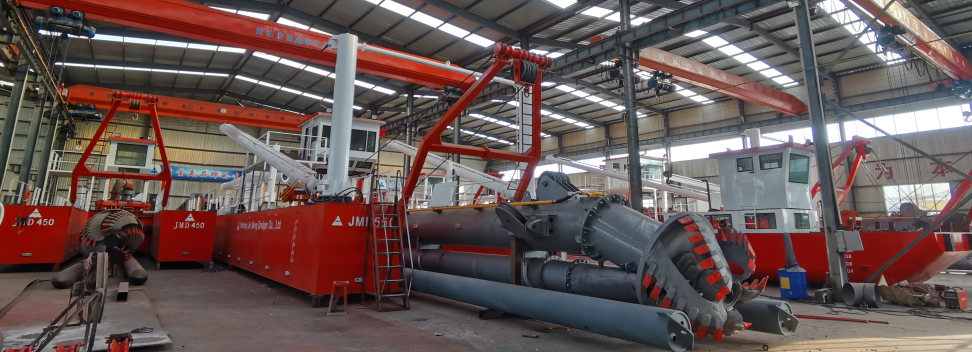
A cutter-suction dredger's (CSD) suction tube has a cutting mechanism at the suction inlet. The cutting mechanism loosens the bed material and transports it to the suction mouth. The dredged material is usually sucked up by a wear-resistant centrifugal pump and discharged either through a pipe line or to a barge. Cutter-suction dredgers are most often used in geological areas consisting of hard surface materials (for example gravel deposits or surface bedrock) where a standard suction dredger would be ineffective. In recent years, dredgers with more powerful cutters have been built in order to excavate harder rock without the need for blasting.
The two largest cutter suction dredgers in the world are currently (as at August 2009) DEME's D'Artagnan (28,200 kW total installed power)[4]and Jan De Nul's J.F.J. DeNul (27,240 kW).[5] both build by IHC Merwede.
Auger suction
This process functions like a cutter suction dredger, but the cutting tool is a rotating Archimedean screw set at right angles to the suction pipe. The first widely used auger dredges were designed by Mud Cat Dredges in the 1980s which was run by National Car Rental, but is now a Division of Ellicott Dredges. In 1996, IMS Dredges introduced a self-propelled version of the auger dredge that allows the system to propel itself without the use of anchors cables. During the 1980s and 1990s auger dredges were primarily used for sludge removal applications from waste water treatment plants. Today, auger dredges are used for a wider variety of applications including river maintenance and sand mining. The most common auger dredge on the global market today is the Versi-Dredge. The turbidity shroud on auger dredge systems creates a strong suction vacuum and creates much less turbity than conical (basket) type cutterheads and that is why they are preferred for environmental type applications. The vacuum created by the shroud and the ability to convey material to the pump faster makes auger dredge systems more productive than similar sized conical (basket) type cutterhead dredges.
Jet-lift
These use the Venturi effect of a concentrated high-speed stream of water to pull the nearby water, together with bed material, into a pipe.
Air-lift
An airlift is a type of small suction dredge. It is sometimes used like other dredges. At other times, an airlift is used, handheld underwater by a diver. It works by blowing air into the pipe, and that air, being lighter than water, rises inside the pipe, dragging water with it.
Bucket
A bucket dredger is equipped with a bucket dredge, which is a device that picks up sediment by mechanical means, often with many circulating buckets attached to a wheel or chain. Some bucket dredgers and grab dredgers are powerful enough to rip out coral to make a shipping channel through coral reefs.
Clamshell
A grab dredger picks up seabed material with a clam shell bucket, which hangs from an onboard crane or a crane barge, or is carried by a hydraulic arm, or is mounted like on a dragline. This technique is often used in excavation of bay mud. Most of these dredges are crane barges with spuds.
Backhoe/dipper
A backhoe/dipper dredge has a backhoe like on some excavators. A crude but usable backhoe dredger can be made by mounting a land-type backhoe excavator on a pontoon. The six largest backhoe dredgers in the world are currently the Vitruvius, the Mimar Sinan, Postnik Jakovlev (Jan De Nul), the Samson (DEME), the Simson and the Goliath (Van Oord).[citation needed] They featured barge-mounted excavators. Small backhoe dredgers can be track-mounted and work from the bank of ditches. A backhoe dredger is equipped with a half-open shell. The shell is filled moving towards the machine. Usually dredges material is loaded in barges. This machine is mainly used in harbors and other shallow water.
Water injection
A water injection dredger uses a small jet to inject water under low pressure (to prevent the sediment from exploding into the surrounding waters) into the seabed to bring the sediment in suspension, which then becomes a turbidity current, which flows away down slope, is moved by a second burst of water from the WID or is carried away in natural currents. Water injection results in a lot of sediment in the water which makes measurement with most hydrographic equipment (for instance: singlebeam echosounders) difficult.
Pneumatic
These dredgers use a chamber with inlets, out of which the water is pumped with the inlets closed. It is usually suspended from a crane on land or from a small pontoon or barge. Its effectiveness depends on depth pressure.
Bed leveler
This is a bar or blade which is pulled over the seabed behind any suitable ship or boat. It has an effect similar to that of a bulldozer on land. The chain-operated steam dredger Bertha, built in 1844 to a design by Brunel and now the oldest operational steam vessel in Britain, was of this type.[6]
Krabbelaar
This is an early type of dredger which was formerly used in shallow water in the Netherlands. It was a flat-bottomed boat with spikes sticking out of its bottom. As tide current pulled the boat, the spikes scraped seabed material loose, and the tide current washed the material away, hopefully to deeper water. Krabbelaar is Dutch for "scratcher".
Snagboat
Main article: Snagboat
A snagboat is designed to remove big debris such as dead trees and parts of trees from rivers and canals.
Amphibious
Some of these are any of the above types of dredger, which can operate normally, or by extending legs, also known as spuds, so it stands on the seabed with its hull out of the water. Some forms can go on land.
Some of these are land-type backhoe excavators whose wheels are on long hinged legs so it can drive into shallow water and keep its cab out of water. Some of these may not have a floatable hull and, if so, cannot work in deep water.
Oliver Evans (1755–1819) in 1804 invented an amphibious dredger which was America's first steam-powered road vehicle.
Submersible
These are usually used to recover useful materials from the seabed. Many of them travel on continuous track. A unique variant[7] is intended to walk on legs on the seabed.[8]
Fishing
Fishing dredges are used to collect various species of clams scallops, oysters or crabs from the seabed. These dredges have the form of a scoop made of chain mesh, and are towed by a fishing boat. Careless dredging can be destructive to the seabed. Nowadays some scallop dredging is replaced by collecting via scuba diving.
Police drag
In some police departments a small dredge (sometimes called a drag) is used to find and recover objects and bodies from underwater. The bodies may be murder victims, or people who committedsuicide by drowning, or victims of accidents. It is sometimes pulled by men walking on the bank.
|